> ## Documentation Index
> Fetch the complete documentation index at: https://docs.gettap.co/llms.txt
> Use this file to discover all available pages before exploring further.
# Action completion
> Whether the things your team promised in meetings actually happened.
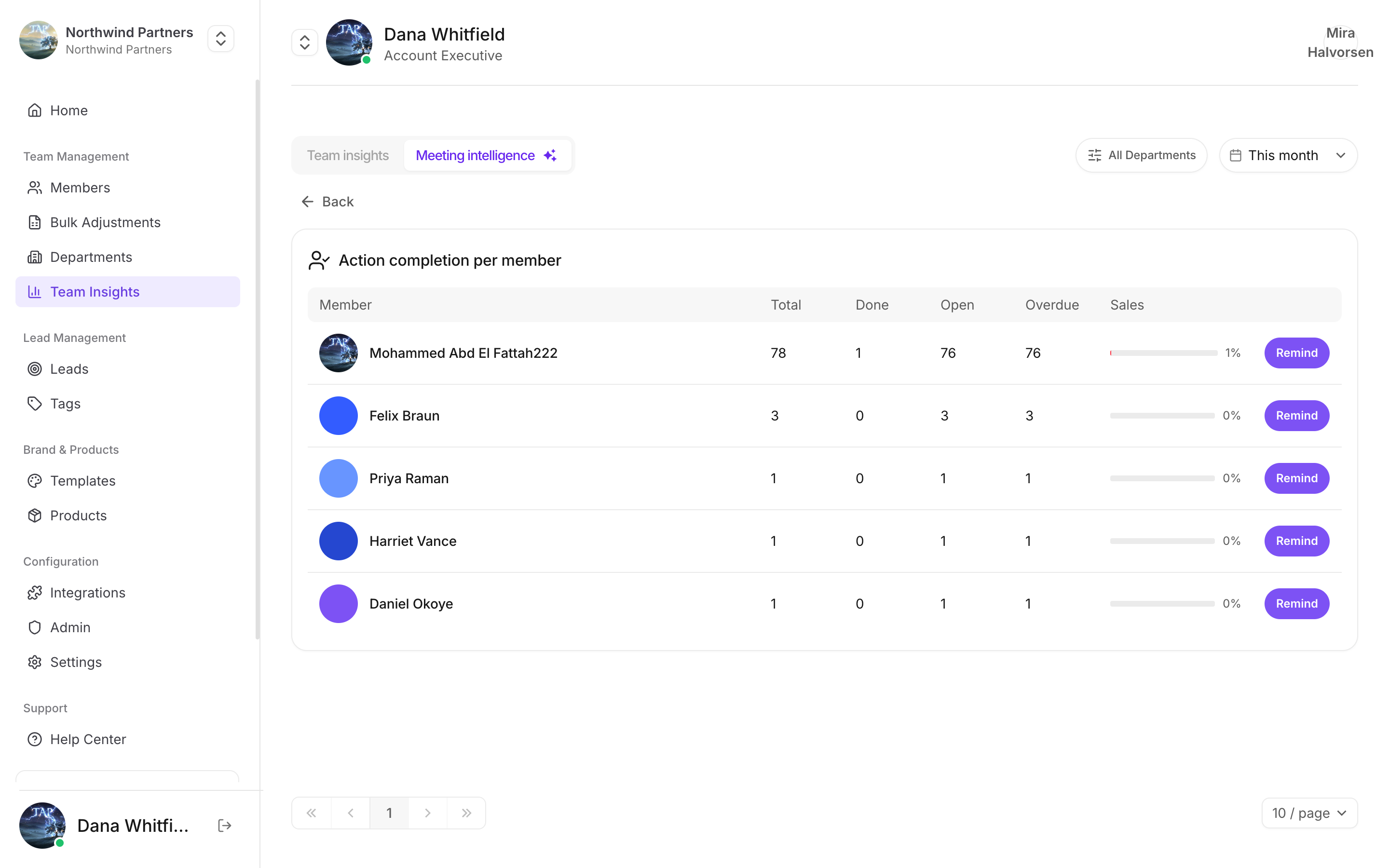
Action completion measures follow-through: of the commitments made in conversations, how many were actually done.
It's the number that most directly predicts whether an event produced pipeline or just business cards.
## Where the numbers come from
Meeting analysis extracts commitments from each transcript — "I'll send the pricing", "I'll introduce you to our solutions engineer" — and creates [follow-ups](/en/leads/follow-ups). Completion is the share of those that get marked done.
This only works if your team marks follow-ups complete. A team that does the work but never ticks the box will show a completion rate near zero. Agree where completion is recorded — Tap or your CRM — and be consistent.
## Reading it per member
The view breaks completion down per person, so you can see who closes loops and who accumulates open promises.
Low completion is more often a capacity problem than an attitude problem. A rep who captured eighty leads at a conference and completed a third of their follow-ups is drowning, not slacking. Read completion **next to** capture volume, never on its own.
## What to do about it
Overloaded. Reduce their capture load, redistribute the follow-ups, or accept fewer leads worked properly. More coaching won't create hours.
Something is wrong that the numbers won't tell you. Have the conversation — it could be tooling, training, territory, or something outside work entirely.
Find out what they do differently and make it the team's default. This is the most under-used thing in the view.
That's a process problem, not a people problem. Usually either follow-ups aren't being marked complete, or the team has no protected time for follow-up after an event.
## Making completion better
The single highest-impact change most teams can make. Follow-ups completed within 48 hours convert dramatically better than ones done a fortnight later, and the context is still in the rep's head.
A rep who can work forty leads properly and captures a hundred has produced sixty cold records and a worse completion rate.
Reviewed weekly it's a working habit. Reviewed quarterly it's a performance review, which is far less useful and much less welcome.
If completion looks bad but the work is happening, the problem is where completion gets recorded. Fix that before coaching anyone.
This documentation is built and hosted on [Mintlify](https://mintlify.com), a developer documentation platform.