> ## Documentation Index
> Fetch the complete documentation index at: https://docs.gettap.co/llms.txt
> Use this file to discover all available pages before exploring further.
# Departments
> Group members so you can control permissions, CRM access, and reporting.
Departments group members — Sales, Field Marketing, EMEA. They exist mainly to carry permissions: nearly everything you can restrict in Tap is restricted at the department level.
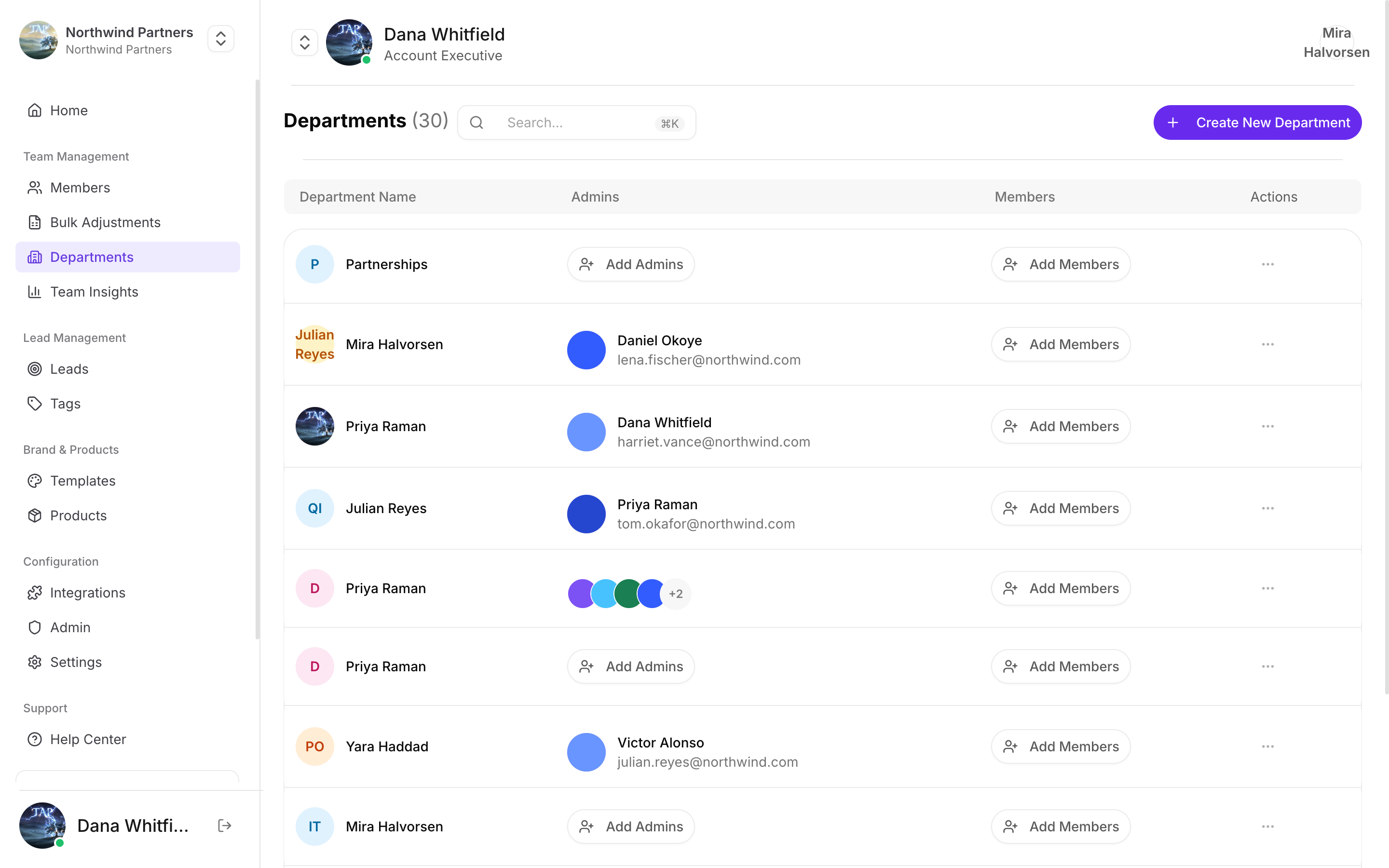
## Creating a department
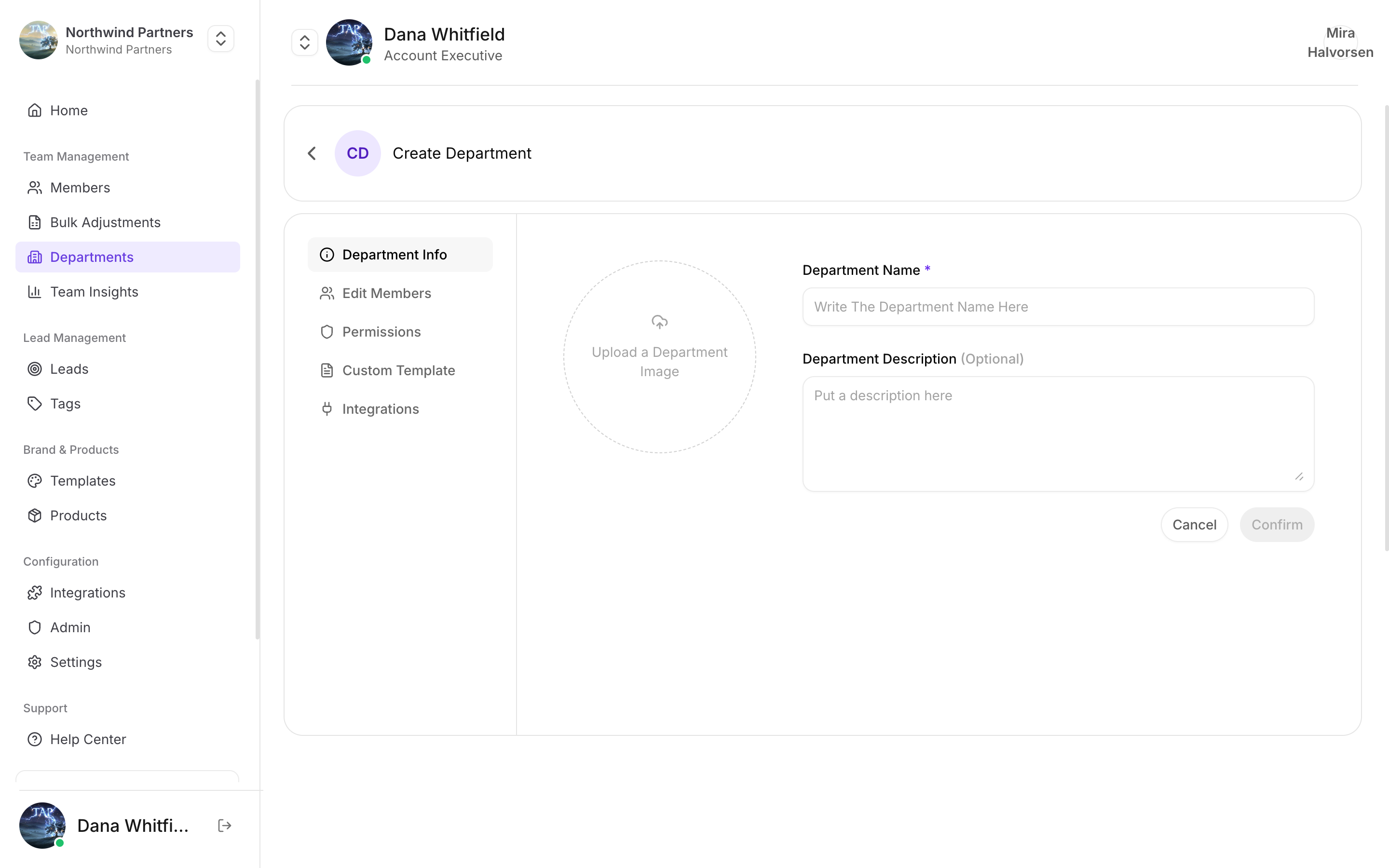
**Departments → Create**.
Use the name your team already says out loud. Import files and reporting both match on this name, so renaming later means updating anything that referenced the old one.
A new department starts with **full access**. Setting permissions is a separate, deliberate step — see [Department permissions](/en/teams/department-permissions).
Creating a department restricts nothing on its own. Until you save explicit restriction rules, its members can edit every profile field and add every link type.
## Assigning members
Set a member's department when you create them, edit them, or import them. Each member belongs to one department at a time.
Permissions follow the **selected profile's** department, not the member record alone. A member whose profiles sit in different departments is governed by whichever profile is currently active — including which CRM connection their leads flow through.
## What departments control
| Area | Detail |
| - | - |
| Profile fields | Which fields members may edit |
| Link types | Which link types members may add |
| CRM access | Which CRM providers members can sync to |
| Location features | Whether location capture is available |
| Sub-admin management | Whether the department can have its own admin |
Full detail in [Department permissions](/en/teams/department-permissions).
## How to structure them
The useful question isn't "what's our org chart" — it's "which groups need different permissions or different CRM destinations". Those are the boundaries worth modelling.
Sales, Marketing, Support. Works when different functions need genuinely different profile setups and CRM access.
EMEA, Americas, APAC. Useful when regions run separate CRM instances or have different data rules to follow.
Executives unrestricted, field reps locked down, temporary event staff fully locked. Often the most practical split, because it maps directly onto how much freedom each group should have.
Don't create a department per person. Permissions are the only thing departments buy you — a department of one is just an unmanaged exception you'll forget about.
## Deleting a department
Reassign its members first. Members left without a department fall back to full access, which is rarely what you want when you're deleting a department precisely because it was restricted.
This documentation is built and hosted on [Mintlify](https://mintlify.com), a developer documentation platform.