
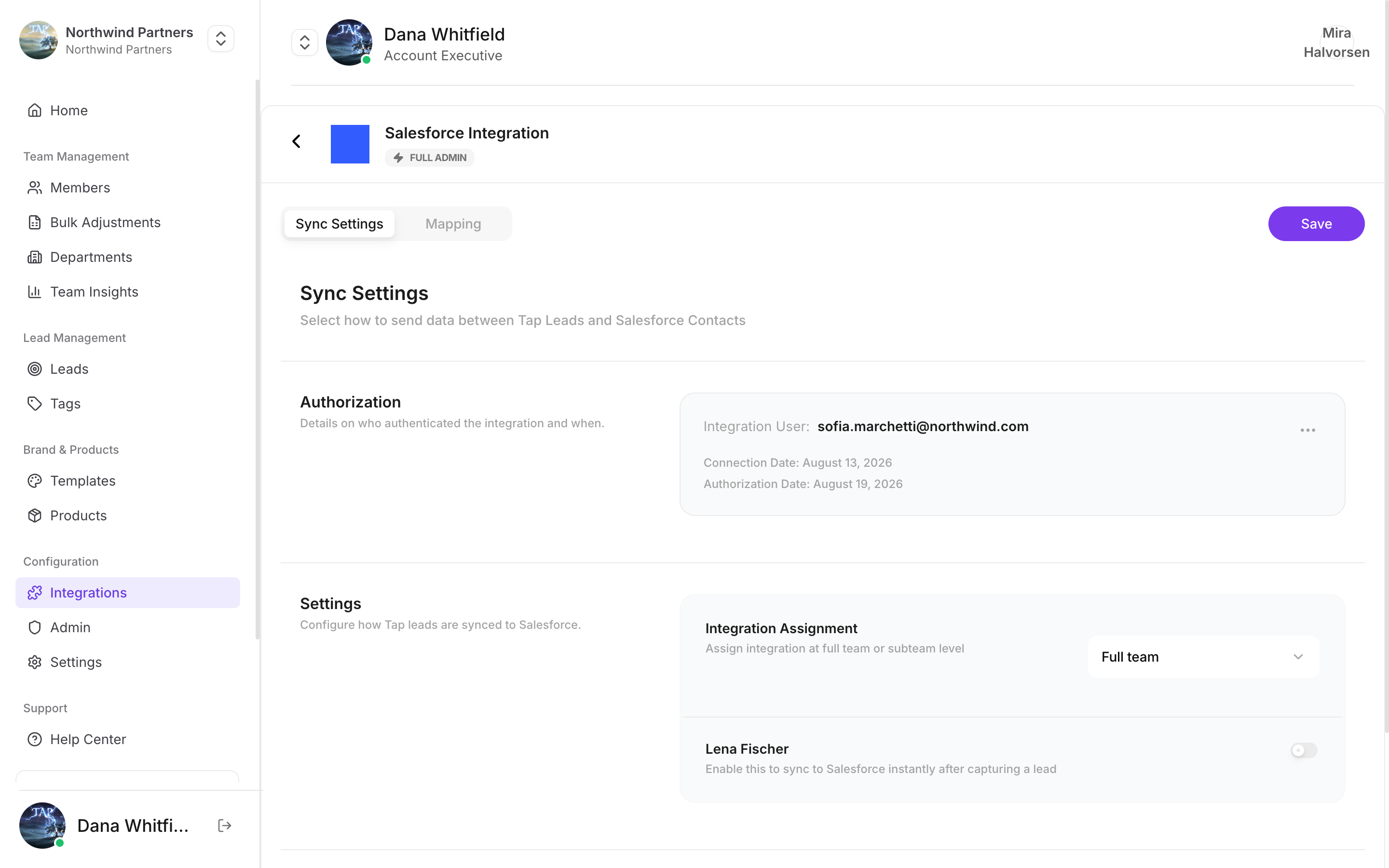
Each capture field pointed at a CRM field
How mapping works
Each mapping is a pair: a capture field’s name on one side, a CRM field on the other.name, never its label. This is why renaming a label is safe and changing a name is not — see Lead capture forms.
Built-in fields
Fields with reserved keys —email, full-name, company-name, phone-mobile, and the rest — map to your CRM’s standard properties by default. Review the defaults, but you rarely need to change them.
Custom fields
Custom capture fields have no reserved meaning, so Tap can’t guess where they belong. Map each one by hand.1
Create the property in your CRM first
Tap can only map to fields that already exist. Create the custom property in HubSpot, Salesforce, or wherever, before you try to map to it.
2
Refresh the field list
Tap reads the available fields from your CRM when you open the mapping screen. If a property you just created isn’t listed, reload the page.
3
Match the types
Map text to text, dates to dates. A free-text answer pushed into a CRM dropdown field is rejected by the CRM, and the whole record can fail with it.
Unmapped fields
A captured field with no mapping is still stored in Tap — you can see it on the lead and include it in an export. It simply doesn’t reach the CRM. This is worth knowing when you add a field mid-campaign: leads captured before you set up the mapping aren’t lost, they just need a re-sync or an export.Updating existing contacts
When a lead matches a contact already in your CRM, Tap merges rather than overwrites. Empty incoming values don’t erase existing data — a blank phone number in the capture form won’t wipe the phone number your CRM already has.Changing a mapping later
Mappings apply to leads captured after the change. Editing a mapping does not retroactively re-sync historical leads. If you need to correct history, export the affected leads from Tap and import them into your CRM directly.Checklist before your first event
Every capture field has a mapping or a deliberate reason not to
Every capture field has a mapping or a deliberate reason not to
Walk the mapping screen top to bottom. An unmapped field is fine as long as it’s a choice rather than an oversight.
Required CRM fields are all satisfied
Required CRM fields are all satisfied
If your CRM marks a property as required, every synced record must supply it. A required field with no mapping fails every single sync — and this is the most common cause of “nothing is arriving at all”.
You've synced one real test lead
You've synced one real test lead
Capture a lead, open it in the CRM, and check each field individually. Five minutes here saves an event’s worth of bad data.
Something not arriving?
Work through the troubleshooting guide.