
Salesforce, Zoho, and Pipedrive create a Lead rather than a Contact. That’s deliberate — someone met at a booth is unqualified until a human qualifies them, and dropping strangers straight into your contact database is rarely what you want. HubSpot and Veeva are the exceptions, because their data models treat the contact record as the entry point.
Supported CRMs
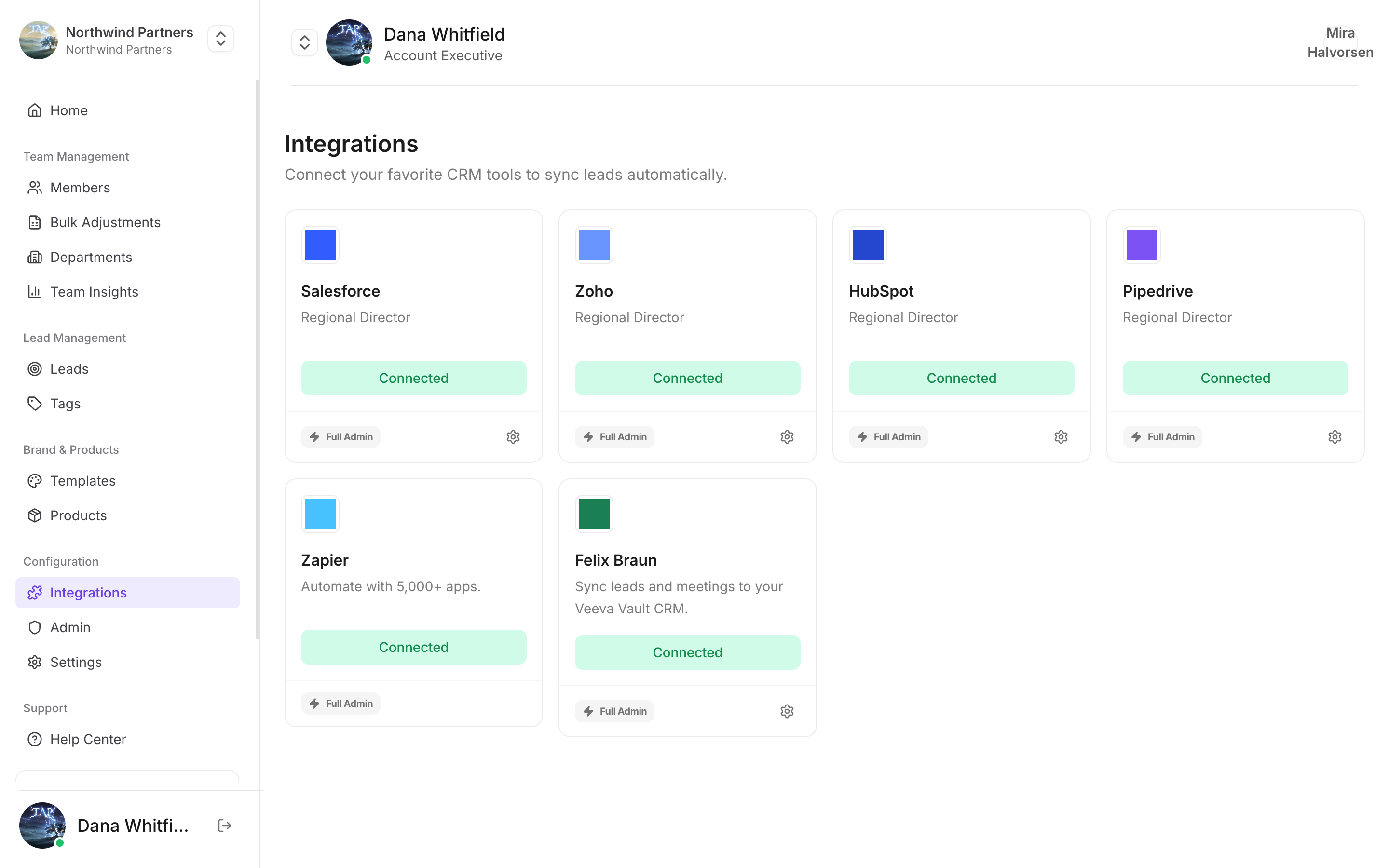
Six connectors ship with Tap Teams
HubSpot
Salesforce
Zoho
Pipedrive
Veeva Vault
Which connection gets used
This is the part that surprises people. A member can be covered by up to three CRM connections at once, and Tap picks exactly one, in this order: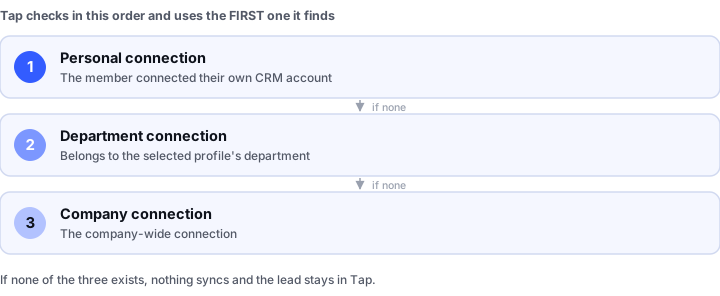
The first connection Tap finds is the one it uses
Personal connection
If the member has connected their own CRM account, that is used — always, regardless of what the company has configured.
Department connection
Otherwise, the connection belonging to the department of the member’s currently selected profile.
Company connection
Otherwise, the company-wide connection.
The department connection follows the member’s selected profile, not the member. A member who switches to a profile in another department starts syncing through that department’s connection.
Lead owner assignment
Separately from which account syncs, Tap decides who owns the record. Tap looks up a CRM user whose email matches the Tap member who captured the lead, and assigns them as owner. Lookups are cached for about 10 minutes, so a newly added CRM user may take a few minutes to become assignable. Owner lookup is non-blocking. If no matching CRM user is found, the record still syncs — it just lands with your CRM’s default owner instead of failing.Connecting
Authorizing a CRM and mapping the capture fields to it
1
Open Integrations
In Tap Teams, go to Integrations and choose your provider.
2
Authorize
You’re redirected to your CRM to sign in and approve access. Sign in with an account that has permission to create contacts and tasks — a read-only account will connect successfully and then fail on the first sync.
3
Map your fields
Match your lead capture fields to CRM fields. See Field mapping.
4
Test with one lead
Capture a test lead and confirm it arrives. Don’t wait for an event to find out.
Department access
Departments must be granted CRM access explicitly. Unlike profile and link permissions — which allow by default — CRM access denies by default. A department with no grants can’t sync anywhere. See Department permissions.Next: field mapping
Decide where each captured field lands.